
There’s a new way to complete Human Check on Gander, and it’s even going to help put food on the table for Canadians who need it.
TL;DR
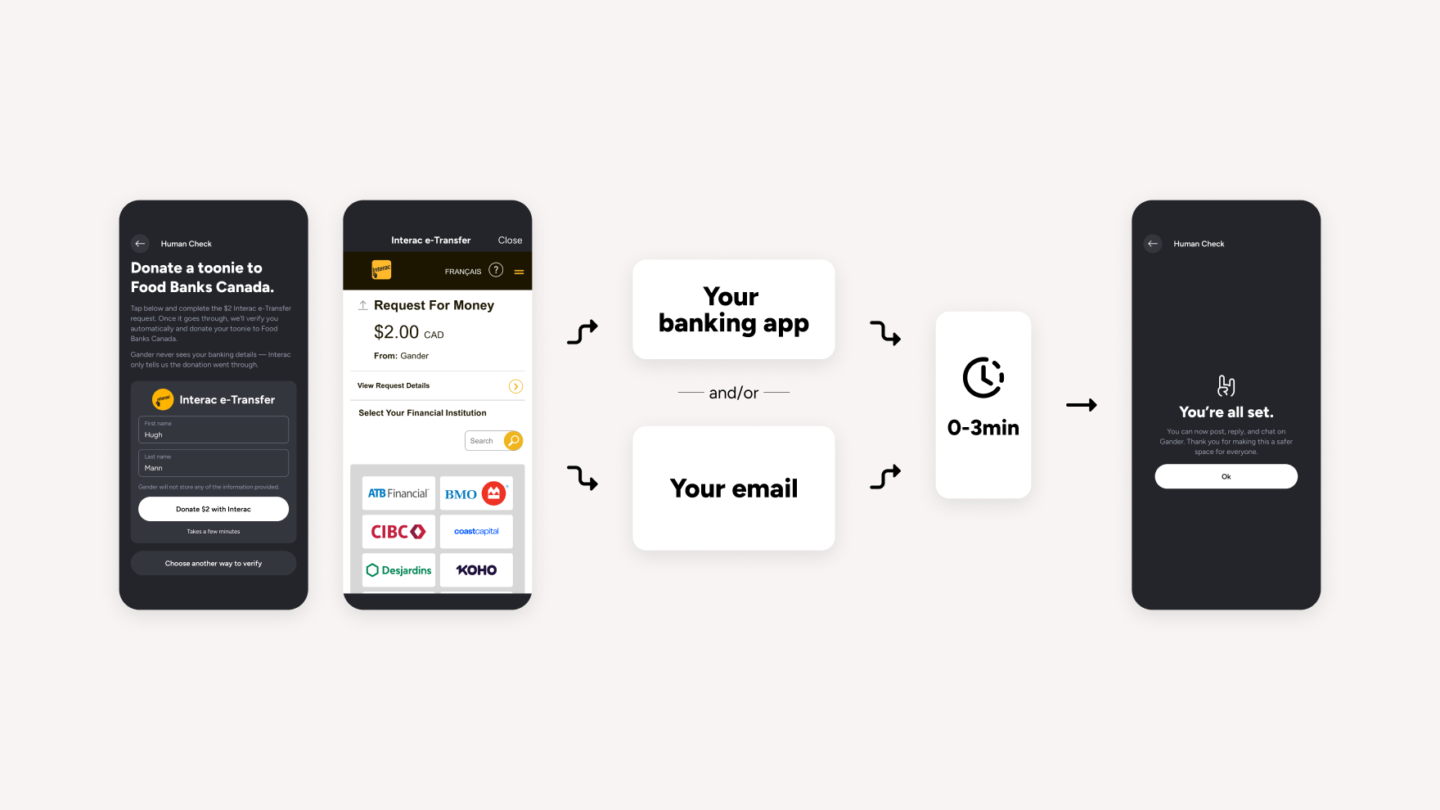
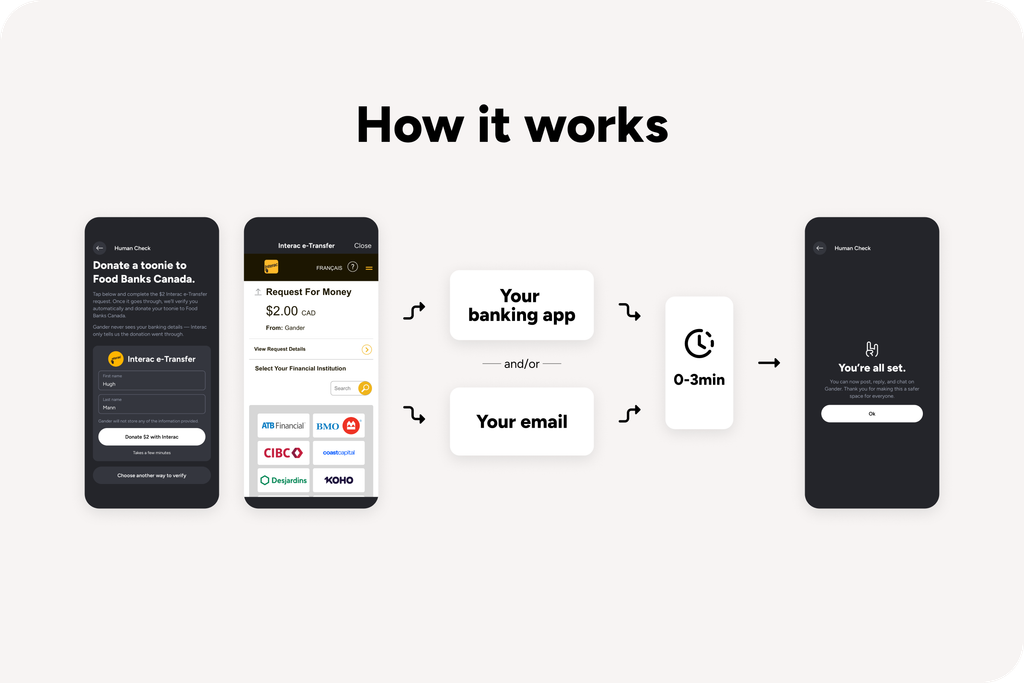
Gander now lets you complete Human Check through a $2 Interac Money Request initiated on Gander. You pay through your own online banking, and the full $2 goes to Food Banks Canada.
- No ID upload or extra app required. Gander never sees your banking details.
- It’s another option for people who can’t (or don’t want to) use Canada Post Identity+.
- You can browse and follow without showing you’re human; Human Check is required to participate.
- It’s a useful signal, not foolproof proof of adulthood. Human Check works alongside moderation and safer platform design.
The goal: make joining the conversation easier, collect as little personal information as possible, and do some good along the way.
We’ve added another way to confirm that you’re an adult human on Gander.
And this one involves a toonie.
Yes, really.
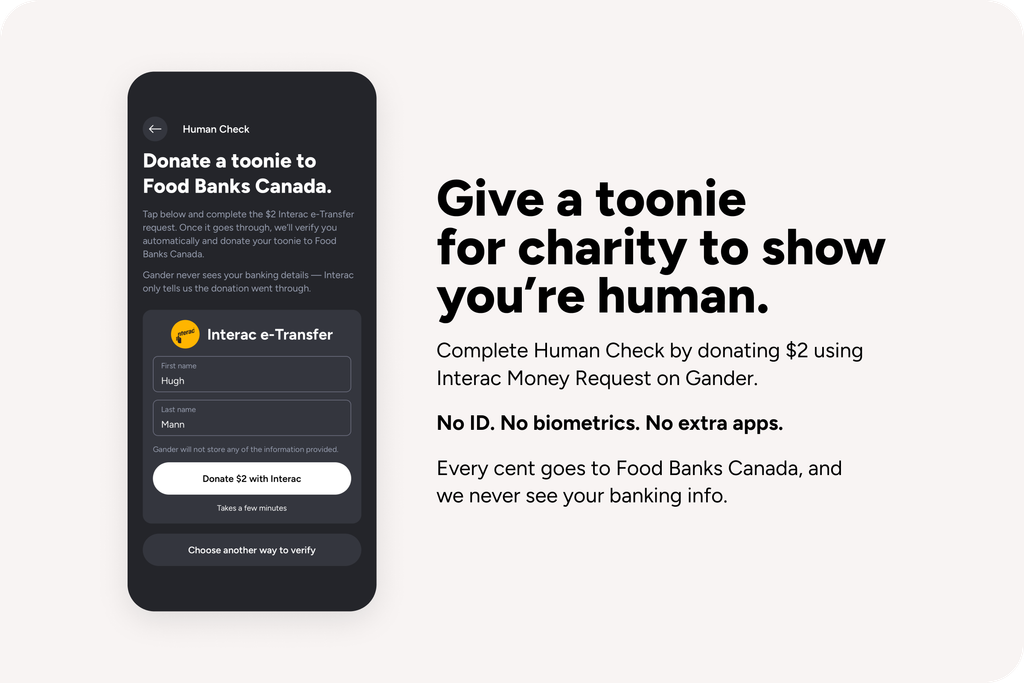
You can now complete Human Check using Interac e-Transfer. We’ll send you a request for two bucks, you complete the transaction via your own online banking, you get verified and Food Banks Canada gets two bucks.
Oh, and we get none of your data.
That little toonie is doing double duty.
Verification isn’t a revenue stream for us. We’re not interested in making money from people confirming they’re human.
So we’re donating every single toonie to Food Banks Canada. Not what’s left after fees or after we’ve covered our costs. The full $2 CAD.
Now, we know what you’re thinking:
“You want me to send two bucks through e-Transfer? To use your platform?”
Fair. After everything we’ve all been taught about online scams, we’d be a little worried if nobody had that reaction.
You should be skeptical. Healthy skepticism is one of the reasons there’s a Gander in the first place. Which is exactly why we want to explain what we’re doing, how it works, and why we think it’s important to give people meaningful choices.
Detecting adult human-ness is tricky.
Back in April, before Gander launched, we wrote a rather long blog about why we were building Human Check. Consider this the second instalment.
We know that you know you’re an adult human. And there are numerous quick checks (like CAPTCHA) that have us believing that they can detect if we’re a human or not. But they don’t. Not with any certainty we’re willing to accept. And they certainly don’t detect one’s age.
We want Gander to be as adult-human as adult-humanly possible. So that means more reliable checks that protect your anonymity without giving us all sorts of personal data to store.
If you don’t know already, we don’t want it.
But what we do want is a space for humans that is protected to the extent it can be from bots and bad actors that would love to pretend to be human just like you, whether to spread misinformation, run a scam or do some other nefarious bullshit.
So while YOU may know you’re an adult human, the only way for us to know you are, is to actually check.
Importantly, you don’t need to complete Human Check to create an account, read public posts or follow accounts on Gander. We ask for confirmation when you want to post, comment or share.
That’s deliberate. Reading something carries different risks than publishing or amplifying it, and we’re of the mind that a safeguard should be proportional to potential for harm.
We hear you. We get it. And we’ve been working on it.
Now that thousands of people have gone through Human Check, we’ve learned a whole lot about how it works in practice. Canada Post’s process takes minutes for some; for others, it’s an ordeal, or it straight up just doesn’t work.
IDs don’t scan, documents expire, people live abroad or encounter accessibility barriers. Some of us don’t have government-issued ID, and others just don’t want to go through the rigmarole to post on social media.
For everyone who’s tried to go through Human Check and run into an issue:
Thank you. We hear you. We get it. And we’ve been working on it.
Our new option doesn’t require a government-issued ID or downloading a separate app. It’s another way to complete Human Check, alongside Canada Post Identity+.
Yes, it does require access to $2 and online banking. And we know that too will be a barrier. We plan on solving that, too. Which is another reason we’ll keep adding more options.
If you’ve had trouble completing Human Check, you can try the new option on Gander.
They’re not all created equal.
There are plenty of ways to establish that you’re an adult human: ID checks, facial age estimation, banking-based methods and information platforms already hold. Each involves trade-offs in privacy, accessibility, convenience and reliability, and not all of those trade-offs are equal.
We think the people making those trade-offs should understand them and have choice in the matter. That’s why we’ve updated our Human Check screens to explain what each method requires, who processes the information and what Gander does and doesn’t receive.
We like choice. But choice isn’t especially meaningful if you don’t understand what you’re choosing.
So, why a toonie?
If you’ve been following us for a while, you might remember that we’ve talked about this idea before. In fact, using a small banking transaction to help confirm someone’s age was one of the original ideas we explored for Human Check.
And we have our brilliant advisor, Blaine Cook, to thank for it.
Which also explains why it’s such an elegant solution. Anyway, enough fanning out for now.
The original thinking was pretty simple: if someone can complete a banking transaction, that gives us a useful signal about whether they’re an adult human. Not perfect, but useful. And it could mean confirming those things without asking people to scan their ID or provide a bunch of other personal information.
At first, we wondered whether we could just use a penny.
But nobody was particularly interested in processing a one-cent transaction. And, frankly, that would look a little strange.
So we settled on a toonie.
The harder part was figuring out how to make it work. We spent a whole lot of time exploring the technical requirements and finding a provider that could support the process without passing along a bunch of information about you that we don’t need and certainly don’t want.
And what about Food Banks Canada?
There’s this pesky idea that what happens online and what happens in the real world are somehow separate things.
But we know that’s not true. What happens online can cause real harm to real people. So why shouldn’t it do a little good in the real world, too?
We chose Food Banks Canada because they support food banks across the country, helping them do more with the resources they have. That includes recovering perfectly good food that would otherwise go to waste and getting it to people who need it, among all sorts of other important work like studying food insecurity,
Our plan is to rotate the organization receiving these donations from time to time. But we didn’t want to hold up another way to complete Human Check while we figured out every detail.
And Food Banks Canada seemed like a pretty darn good place to start, especially these days.
Easier isn’t always better.
Finding the right provider taught us quite a bit about how verification services work.
We’ve read an awful lot of technical specifications and spoken with a lot of providers. Some have been genuinely surprised when we’ve said we don’t want people’s biometric information, or their names, birth dates, and addresses.
It’s been harder than we’d hoped to find services that share our approach to collecting only what’s necessary.
We’ve also learned that the method that feels easiest isn’t necessarily the one that involves the least personal information.
Take surveillance-based age inference.
Some of the biggest social media platforms can already make a pretty good guess about how old you are. And why wouldn’t they? They’ve spent years collecting information about you.
What you watch, what you post, what you click on, who you interact with, even the birthday messages people leave on your profile. All that information helps platforms build detailed profiles of you, target ads at you, and make money from what they know about you.
And it’s made them so, so, so much money.
Piece enough of that information together, and they can infer your age without ever having to ask.
Which is pretty creepy, when you think about it.
If these platforms already have the information and technology to infer someone’s age, they can use it to put additional safeguards in place, too.
They haven’t, but they could have. Which raises a pretty reasonable question about why those protections weren’t introduced sooner or applied more broadly, given how long platforms have been collecting and analyzing this information.
There’s also the bigger question of whether keeping people safe should depend on collecting all that information about them in the first place.
That’s information we don’t want to know about you.
We don’t want to study your behaviour for years to figure out who you are. We certainly don’t want to build advertising and surveillance infrastructure just so we can infer whether you’re old enough to participate on Gander.
Not every age-assurance technology works this way, of course. But something being almost effortless doesn’t make it private or less invasive. Sometimes it’s effortless because the platform already knows it will learn more if they pull aside the velvet rope and leave it there.
Presumably it’s all explained somewhere in the Terms of Service. You know, those things we all definitely read in full, all the time.
We’d rather ask you directly to confirm your adult humanness, explain what’s involved, let you choose, and not collect a bunch of data on you we don’t want. All while recognizing that ID and banking methods have privacy trade-offs of their own.
So Human Check asks a few basic questions: is there a real person behind the account, are they old enough to participate, and can we make mass creation of disposable accounts harder?
Human Check still isn’t identification. Pseudonyms are welcome. We don’t need to know where you live, your exact birthday or a database of everyone’s ID.
With Canada Post’s Identity+, we receive the Human Check results we need without ever seeing your ID or the personal information on it.
And with our new online banking option, Gander never sees your banking details. Interac only tells us that the $2 transaction went through. We don’t receive or store the banking information you provide to complete it.
That’s the general approach we’re pursuing as we add more options too.
Still not perfect.
The toonie isn’t magic either. A successful online banking transaction, by itself, doesn’t 100% beyond a shadow of a doubt prove someone is over 18.
Young people use Interac e-Transfer with parental permission, while some adults don’t have access to it or don’t want to use it for Human Check.
Canadian researchers have examined these trade-offs. Andrew MacDougall at McGill’s Centre for Media, Technology and Democracy found that no single age-assurance method is perfect.
The Office of the Privacy Commissioner of Canada likewise emphasizes that privacy depends on what a method collects and how that information is used, not what the method is called.
We’re not chasing perfect certainty at the cost of your privacy. We’re trying to make participation safer while collecting as little information as we can, and we’ll keep adding ways to complete Human Check.
And Human Check is no substitute for building a healthier platform. We still have to moderate, respond to harm and make design choices that don’t deliberately exploit people’s attention or push them into conflict. We can’t verify our way out of every problem.
The toonie is another option, with its own advantages and limitations. No doubt about it.
But if we can make it a little easier for someone to join the conversation while helping put food on someone else’s table?
Not bad for two bucks.